Category Archives: General Posts

VW LT (Florida) Skylight Installation

I have put together this guide as a one stop shop for anybody that may be considering making such an alteration. As with any such modification there are always going to be alternative ways of getting to the same end result, but I feel that this may be a good basic insight to what is involved.

Our van was made in 1990 and the original skylight above the living space had clearly seen better days and was starting to let water in during heavy rain. We had noticed a few times that the bedding was damp when we had collected the van from storage as we tend to leave the upper bed down most of the time. However, I didn’t realise just how bad the situation was until I got the ladder out to have a closer look.

Suffice to say we could no longer put off replacing the unit. I had been watching a few people on social media replace their original skylights for similar reasons, and one of the options was the Dometic Heki 2. This was considerably larger than the original, so a definite upgrade in relation to the amount of light it would let in, and improved ventilation during warm weather. That said, at £640, the cost was the main reasons we had delayed it so long.

The first thing to do was to remove the original skylight. Inside the van the plastic trim was held into place by a number of self tapping screws which were hidden behind small plastic lugs. There was also a self tapping screw that held the winding handle on. I positioned a set of step ladders against the side of the van with some foam to provide padding where they rested on the van. This gave me reasonable access to unit from the top. If you do not have the Fiamma roof box fitted at the rear, or a solar panel as is the case in my situation (you can see this to the left of the picture below), you may prefer to climb the ladder at the rear and work your way forward from the back. Just be mindful of where the roof support bars are beneath the fiberglass structure, and use those.

The original unit was fixed into place by Mastic tape, and the only thing properly securing it to the roof were the parts we had already removed inside the van. So with a little prying and some gentle persuasion the original unit was removed,

Moving back inside, It may be a good time to consider protecting as much of the interior of the van with dust sheets or blankets as there is no real way of keeping the van free from dust and debris during the process going forward. Carefully remove the ceiling trim. This is made of thin ply so be careful as you work the ceiling out of the grey rails. You only need to take the piece surrounding the skylight itself!

This will expose the fibreglass wadding / insulation. This is nasty stuff and can irritate the skin and cause chest issues. I would recommend suitable clothing with full length trousers and long sleeved top (overalls ideally), along with a face mask, eyewear and gloves. Don’t wear shorts and T-Shirt like I did…”Do as I say and not as I do” 🙂 . The wadding is glued to the roof so a wide wallpaper scrapper would be the ideal tool to get behind and carefully manipulate away from the roof to remove. Place the trim and wadding on one side as these will need to be modified later to fit the new aperture.

The next thing to do is to mark the roof ready for cutting making sure this sits in between the roof metal roof supports. I used the template that’s printed on the outside of the box that the skylight is shipped in.

This was cut using a scalpel and scissors. Its a little confusing as the cut line is 5-6mm thick, leaving some ambiguity. The dimensions of this skylight is 960 x 655 mm. Measuring the template this falls at the very outer edge of the black line.

That said, I decided to cut slightly in of the line, which meant the hole was smaller with the option of opening out if too small. This was the case, but better that way than to have the aperture too large with no option to add material back.

I offered the template up on the inside of the van and estimated that there would be between 8 and 10mm of room if the hole was cut centrally, front to back, between the roof supports. With this information to hand I measured 8mm back from the front roof support at two locations either side of the van and made a mark.

This would be about 850mm apart, or 425mm off the vans centreline, but well within the template of the skylight, before the curve (See below).

P.S. If you are anything like me, you would double and triple check that you are clear in your head why you are doing what you are doing, and that you have your measurements right, because this is the point of no return!! With these reference marks made I took drill with a 2mm drill bit and drilled up and outwards through the fibreglass roof.

From the outside of the van this would provide a valuable visual reference in which to draw a straight line connecting the two drill holes. (I apologise for not documenting this with photos as I was up against the clock to some degree). I also marked the centre line of the van roof externally based on the original skylight position, and in turn marked the centre line of the cardboard template. From here I could use those two reference lines to centre the template on the roof, and align the long front edge against the drill bit line. Once the template was in position, I taped it to the van roof and drew around it.

There were a couple of different ways to cut the roof. Suggested for the rounded corners were a 130mm core drill with the straight edges cut with a 1mm cutting disk on an angle grinder, or a jigsaw. As seen in this gallery below, a very neat solution to making the roof hole by Peter Ferry.

Alternatively the whole roof could be cut with the jigsaw. I chose the jigsaw route due to the fact I couldn’t get the core drill short notice locally. With the starter hole done with a 10mm drill as a starting point to drop the saw blade in, I used a a narrow profile blade similar to the one pictured below, as this would offer better and more precise work at the rounded corners.

Narrow Jigsaw blade similar to that used to cut the roof.

I found the best way to access this whilst doing the cut was to move the upper bed into position (after removing the mattress and furnishings) and stand up on that, through the old skylight aperture. I worked my way around the marked line during the cutting, stopping at intervals to stick gorilla tape between the two cuts to support the inner part, which would eventually be the discarded part of the roof. Once the final part had been cut I removed the gorilla tape and the waste material. You can see the part removed in the image below which still has the Gorilla tape stuck to it.

The next thing I did was thoroughly clean the roof around the aperture. I used Cif on a sponge and cleaned with a damp cloth. This is suggested in the fitting instructions, and the main reason (if not obvious), is to present a suitable surface to provide good adhesion between the roof and skylight at the point the components are assembled for the final fit.

Once this was done it was time to drop the new unit in. For me this was a process that took a couple of attempts as I had cut the hole slightly small. This was refined to the point where it eventually dropped in. The tolerance suggested is 1 > 2mm of clearance around the unit. I can only assume this was for any slight expansion / contraction of materials.

As I eluded to at the start of this post, I never really felt comfortable about the fitting of the skylight because there were a lot of unknowns, and the major concern around taking a hacksaw to the roof did not fill me with confidence. The advice I had was good, but insufficient quality photos at every stage to make it clear in my head exactly how the whole thing went together, left a lot of questions remaining. I had the new skylight and some instructions with it, but until fitting, it was never really that clear. So as the install moves forward there was a few head scratching moments to come.

I had brought a couple of different sized batons of wood to act as bridging pieces / packers, as I had been advised that this is what I would need to assist with the install. It wasn’t until I had dropped the skylight in that I could really start thinking about how this was all going to fit together. The fixing kit that comes with the skylight is for the shallowest roof depth, which is 25mm – 35mm and colour coded ‘Grey’. The actual roof depth of the Florida is between 45mm – 50mm dependant on where you are measuring from. Other fixing kits are available and come in different colour coded options dependant on their depth to cater for the appropriate roof depth.

The information I had from other people installations was that the grey kit would work OK if the fixing screws that came with the kit were changed for longer ones. I decided to go down this route after a little testing as I couldn’t see it would be a problem. That said, I did see that another person chose to use the ‘Yellow’ fixing kit so this may be an option others may want to consider. Especially if you can buy the kit in advance of the installation under the agreement by the supplier this can be returned if not required if you don’t use it, as it is an extra expense at approximately £45.

The replacement screws I used can be seen above, and were 15mm longer for the longest screws (40mm), and 10mm longer for the shorter screws that are used to fix the lower trim (25mm).

I decided, that two lengths of 20mm x 25mm wooden batons would work for the 5 fixing points along the long edge of the skylight which would brace up against the metal roof supports. These were laid with the widest face top to bottom , narrowest front to back.

I didn’t feel the length was critical, but just long enough to provide a decent level of pull into the roof beyond the outer two fixings. The batons left and right for the 3 outer fixings were 25mm x 35mm and were cut to fit in between the two metal roof supports with the deepest profile top to bottom, narrowest against the roof / fixings.

The initial fitting was just a dry run to make sure that the roof pulled in sufficiently when all of the fixings were torqued down. This was more of a test for the sides as the roof of the van does start to slope off further out. Not massively, but this is where there will be a gap.

Once I was happy that everything was within tolerance, I proceeded to remove the skylight ready for the final installation.

I chose to follow the advice I had from others to use W4 Mastic Sealing Tape to secure the skylight to the roof. It comes in varying widths, primarily available in three standard widths, 19mm, 32mm, and 45mm. The other option was Sikaflex, but there would be no way back from the install with that, should something go wrong, as this a ridiculously powerful bonding adhesive, where as the tape would be more forgiving. I used 19mm for my install.

With the skylight out and lying face down, run the tape into the channel (depicted in purple on the image below). I found at the corners it was better to remove the backing paper and slowly work the tape in uniformly, or else the paper makes the tape pucker up. Then continue along the next edge. Rinse and repat till you meet the start point. I did have one messy corner (the first in the run) where the tape had puckered up due to not removing the backing paper. I’m hoping it’s OK. Just try and follow the above considering my explanation.

Before I dropped the skylight back in, I ran a bead of quality white bathroom sealant along the inner edge of the mastic in the corner, all the way around as a belt and braces approach. This is depicted as the blue line on the image above (Again, sorry for lack of images at time of install, I have just had to improvise).

Now repeat the fitting procedure as done previously with the dry install, and torque in to the roof, checking its seated sufficiently close on the outside.

Next you will need to mark and cut the inner roof liner. I used a ruled and made sure that it was pushed as far as it would go into the outer grey locating bead (where the plywood roof trim sits), and measured to the mid point on the grey roof fixing.

Transpose this measurement onto ceiling trim and work your way around for each edge. I marked the trim on the upper face (not the visible face), but just make sure you understand the orientation as it may not be equal distance / mirrored. I found that this should roughly align with the original roof template if place on top.

As far as the corners are concerned, I chose not to round off the edges as per the original template, but cut diagonally to leave a little more material there. The main thing is that the roof liner doesn’t get in the way of the lower (HEKI) trim fixings screws.

Once the roof trim is in place, you can offer up and assess the lower (Heki) trim fixing points. I could see that the outer three on each side were almost perfect, where as the 5 on the front and rear edge looked like they needed some spacers (or the alternative yellow fitting kit if purchased prior to install) . I found a sacrificial rubber mat in my garage that looked like it would be a suitable depth to form a spacer. I cut it into ten small packers, drilling a hole in one side to align with the screw hole for the lower HEKI trim, and stuck them on each of the grey fixings with double sided tape.

I then offered up the lower trim and carefully screwed it into position being careful not to over tighten. I tested the operation of the blind from time to time, and all seemed to work fine. However, I have been advised to take care as you do this as any twisting of the lower frame could case issues with the blind movement.

So all that is required now is to fit the trim to hide the screw fitting points, and that is the end of the install.

I hope you found this guide useful. I have tried to do my best with this, and it seems to make sense to me, but there may be some points that are not clear and need some refining. If you could post a comment with any suggestions or questions it would be much appreciated.

Lambretta Li (AFP 387D)

The last scooter I owned was my beloved 1979 Vespa PX125. I brought this back in the early 90s and eventually modified it with a wide tyre conversion kit, reed valve and big carb. During this time I also owned a Vespa T5 Classic, which was also modified with a wide tyre conversion, but this was stolen unfortunately in 2001, and I parted with the PX a few years later.

I had distractions with various other vehicles in the form of cars, motorbikes and campervans since that time, but I guess it was only a matter of time before I got the longing for another classic scooter again. This time I decided that it would be a Lambretta due to the fact they tend to be a little rarer, as they stopped making them in the late 70s / early 80s, many years before the Vespa’s, whose last scooter came off the production line in 2017.

I briefly owned a similar scooter some years back, and always regretted selling it, but it was a case of last in, first out at the time. I never really rode it as it was brought as a project bike, so I guess I had unfinished business from that perspective.

So for a period of time I casually browsed Facebook marketplace, and as you do the algorithm feeds you more and more of the same. There were a lot of Lambretta’s that had been completely overhauled with a nut and bolt resto. This certainly wasn’t what I was after. I wanted something with original paintwork and all of the patina that comes with that. I saw one of two, but I was on the fence at the time.

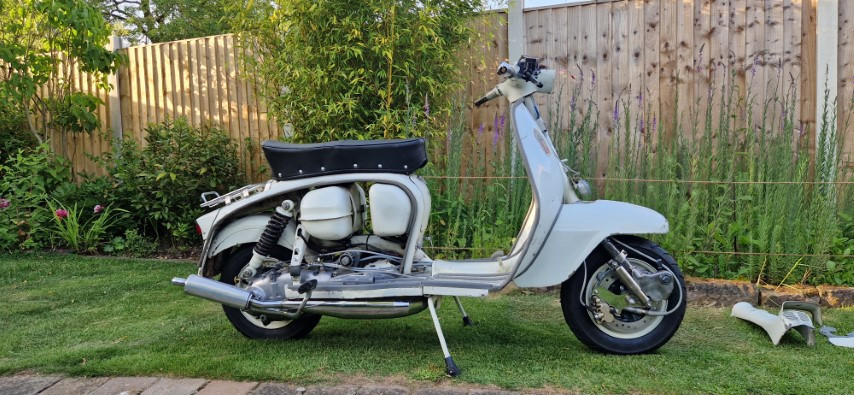
Then this 1966 Lambretta Li 125 came along just a few miles away.

We arranged to view later that evening, and after a chat with the owner, who told me he brought the scooter off of a friend that had it in his barbers shop for a few years before selling to him, the deal was made.

So the Lambretta ticked all of the boxes as far as looks and patina. Of course I didn’t need to test ride it before parting with my hard earned cash. It would ride beautifully….right?

The scooter was dropped off at my house late one Saturday morning, and shortly afterwards I started to familiarise myself with the mechanics. I know that it had had very little use on the road as the previous owner had just done a couple of local classic vehicle events on it, and the friend he brought it from had it as a prop in his barbers shop. This didn’t inspire me with confidence that it would be fit for anything other than a trip round the block, and the preliminary overview of the cables and controls pretty much backed this theory up.

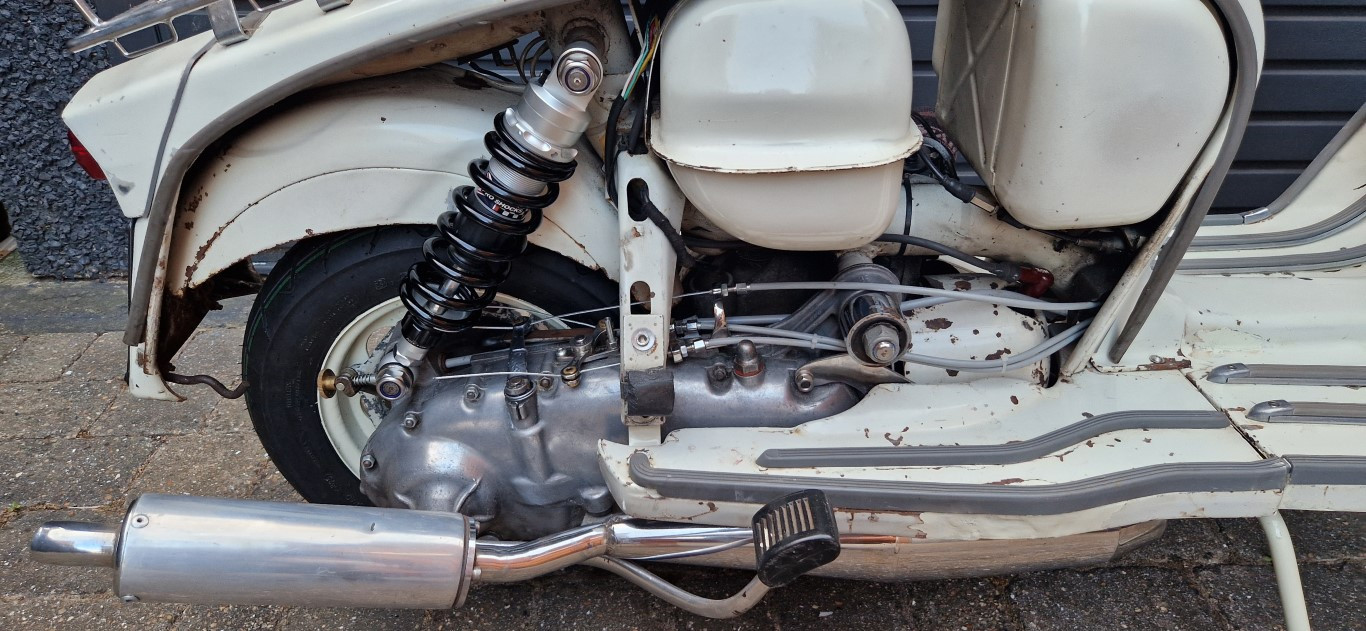
Example of the rusty / corroded engine controls and fraying cables…

Anyways, I plucked up the courage to have a spin out on it, and I must confess, it was a death trap. The gear, clutch, brakes, suspension and steering were an absolute nightmare. On the other hand the engine pulled like a train, so there was one positive!

I had always maintained my motorbikes and scooters myself and this wasn’t the first time I had been in this situation before. I knew this was going to take a little TLC to get on top of, and I was hoping that replacing a few cables, and a little general maintenance, was going to be enough to delay having to sink a wad load of cash into this project early doors. However, the more I investigated, the more I realised that this was unrealistic.

Not knowing a great deal about Lambretta’s , I started to embark on a steep learning curve, peeling away parts to remove the cables in anticipation of running in a new set as a first port of call. I should have realised at that point, that over a period of the next six months, the scooter was going to be in a gradual cycle of less and less components as the full realisation of just how little maintenance the scooter has had in its lifetime.

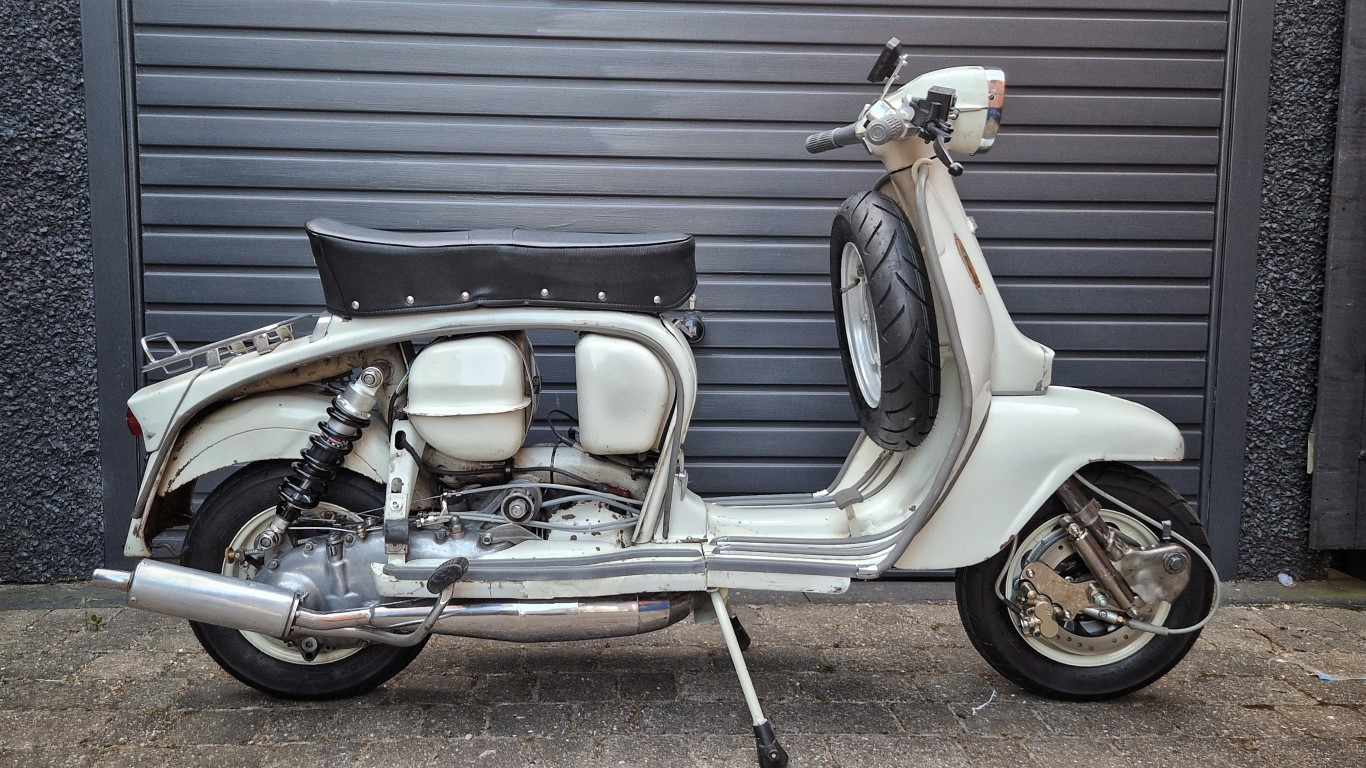
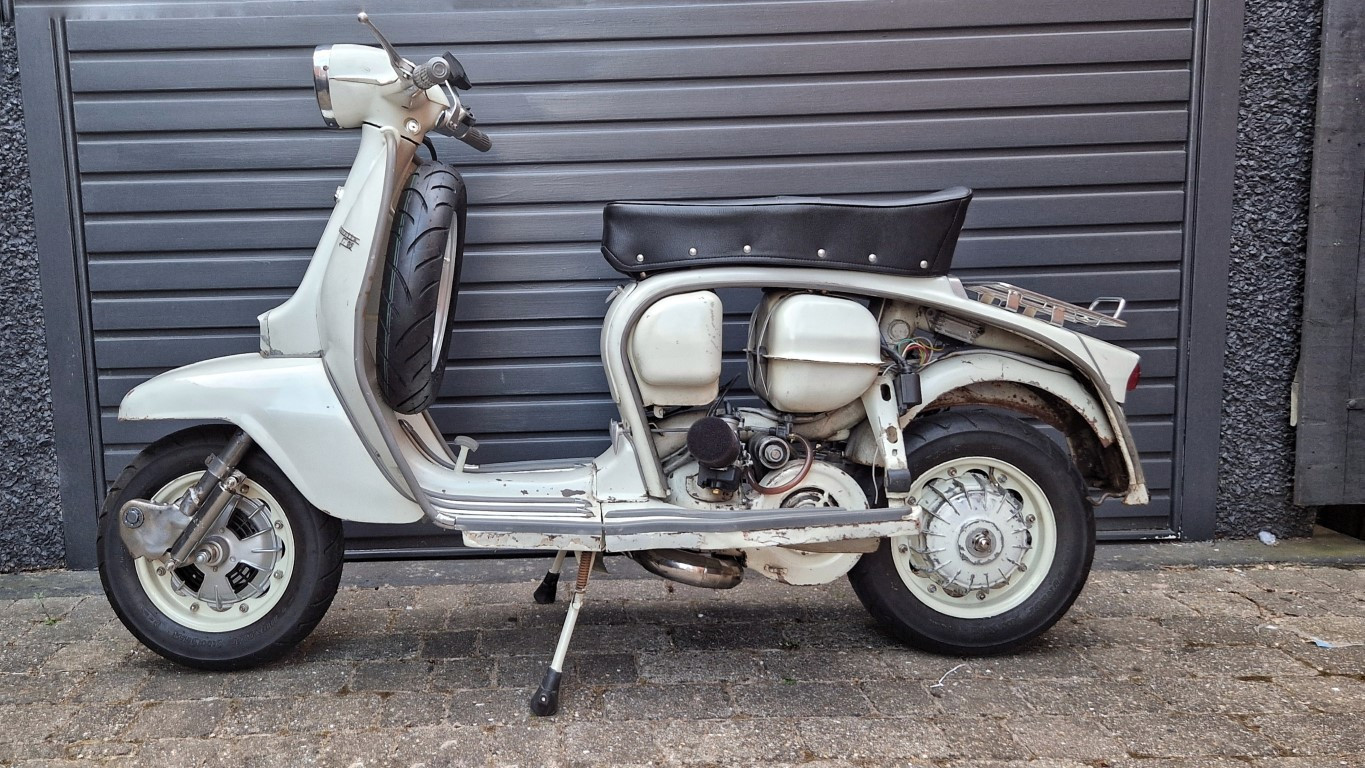
As mentioned earlier I loved the look of the scooter and the amount of history that was showing in its paintwork. The scooter was made in 1966 so there was a lot going on, and can only assume that the paintwork was original. My intention was to preserve as much of this as possible, with upgrades to the mechanics and the installation of a stainless performance exhaust that was a part of the purchase, along with a front disk brake in time.

The leg shield below was an example example of how i tried to sympathetically renovate the paintwork. After removing the footboard runners, there were areas of exposed metal that would be prone to corrosion if water got under them once rebuilt. I decided to mask around the the runners and paint with Rustolium. I had this paint made up for my campervan, and it was a very close match for some of the touch ups I had to do on this project. Not exact, but good enough. I made a point of only masing out where the runners would hide the metalwork, leaving areas outside of that to retain the rust and patina.

Leg shields and runners removed and mased ready for paint.
Paint applied under floor runners

During the strip down I noticed the word MADSPEED stamped onto the engine casing. I did a little research and found that this was a tuning company that had been tuning Lambretta’s for years. I contacted the tuner and found that this must have been one of the earlier Madspeed tuned engines as he didn’t originally number the engines. Later engines were numbered possibly to keep a record of the state of tune and the components used. Makes sense. This turned out to be a welcome surprise, and obviously the reason the scooter seemed to pull so strongly during the test ride.

Photos taken during renovation

Antwerp – Belgium

Antwerp…. where do I start? As we researched this campsite prior to arrival, we found that we would need to pay a fee as we were going to enter the emmission zone. When we arrived the facilities were basic and the campsite had a slightly run down fee to it, but this was quite probably to do with the gloomy conditions we arrived under. Slightly overcast and damp. However, conditions improved, and we fell in love with this location as you will see.

On day two of our stay we headed out on the bikes and explored a local forest pathway. From there we became a little more adventurous and used free ferries from our camp site ‘City Camping Antwerp’, to get across the river Scheldt. And also the free tunnel, who’s 32meter depth is either traversed by an escalator, or a large lift.

On our second full day, we decided to cross river again, and skirt the city on bikes to visit the Antwerp Zoo. From what we had read, and seen online, it looked like a worth while trip. The weather was great, and this became one of the best decissions we made. These things don’t tend to appear cheap when considering buying a ticket, but it was well worth the money, and a real jewel in the crown of the city of Antwerp.

https://www.citycampingantwerp.com/en

Ghent – Belgium

We left Bruges yesterday morning and headed to Ghent, which took less than an hour under poor weather conditions. When travelling abroad I’m used to spending hours behind the wheel between destinations, as we have previously skipped from one country to the next. So this time is nice to be traveling shorter stints, with the added advantage of being able to dedicated more time to exploring. Belgium, so far has not disappointed.

Ghent was the second city of our two week tour, and although similar in some ways to Bruges, It was different enough to make our trip worth the while. We cycle in to the centre from an Aire a couple of miles out of the city just as the rain began to cease.

Really impressed with the cycle infrastructure, and we both feel really safe, with dedicated lanes which give bikes priority over other vehicles.

Our step count was understandably high after exploring this amazing place by foot, and opted for a 50 minute guided boat trip, which turned out to be entertaining, and informative at the same time. We got back to the van tired, but happy with the days activity, based on the fact the day started wet and gloomy.

2024 Belguim Trip

This would be our first trip back to the continent since our Euro Trips in 2019 pre covid pandemic. We were really looking forward to spreading our wings again, but could not commit to traveling too far afield due to work commitments. The most we could take off work was a couple of weeks. So after scouring the map of possible desinations from Calais / Dunkirk, we decided that this trip would cover the best that Belgium had to offer.

Mandy and I finished work on Friday, and headed for Dover at 8pm after a birthday barbeque. We arrived at 1am Saturday morning and managed to get 3 hours sleep before catching the 7am ferry to Calais.

At this stage we had just commited to the first few nights at a campsite in Brugge we stayed at in 2018. We knew was a reliable first port of call where we could unwind, explore and plan the rest of the trip.

September 2023 Vacation

The initial focus of our annual two week September holiday was to coincide with a weekend at Blackpool Sands for the ‘Vans on the Sands’ campervan beach hookup. This meeting was in the best location, and always proved to be excellent, as it included ‘the best’ ingredients you would ever want in a camp over. It’s never disappointed!

However, with a potential five hour drive from Derby, we thought it would be prudent to split the journey in two by leaving on the Wednesday after Mandy finished work. We stopped at Gloucester Services and had a coffee, which, by this point Mandy had started to tire as she was in the driving seat. We agreed that we had made good progress and looked for a stop over referencing the Park For a Night app on our phone. We found one a few miles away at Stroud.

It had just started to get dark when we arrived at the location which we knew to be along the canal a couple of miles out of the town centre, so we secured the van and went to bed after a snack.

Stroud

Knowing that we were ahead of schedule as far as the travel south was concerned, and the fact we couldn’t really set up camp at Blackpool Sands for the meeting there until later on that evening, we had time to kill. Mandy suggested that we investigate Stroud, and having the bikes on the back of the van gave us the perfect way to get there.

We woke up and had a peek out of the window to see the early morning sun attempting to get through the trees that surrounded the parking bays. We could also hear the noise of the A road nearby, but it was just a gentle reminder how easy it was to get to this location the night before.

The cycle route mainly consisted of canal paths, so this was really nice, and to put context to the time of day, we locked the bikes up and had to wait for the Curio Lounge to open for a coffee at 9am 🙂 . We were both in a really good space knowing that we had a couple of weeks to sit back, chill and enjoy the time away in the van.

We found Stroud to be a great (unexpected) location to have had the pleasure of visiting. The shops seemed to have had a biased amount of shops selling indian style, boho retro hippi clothing. We thought that might have had something to do with Glastonbury, but realised it was maybe a stone’s throw too far. Suffice to say we both brought items of clothing.

Blackpool Sands

Well this was the whole reason to head ‘down south’ for the annual September vacation, and this year was not going to be a year to disappoint. The weather was excellent, and, for me I felt much more connected and engaged with the whole experience, than I had done since I had first attended the event back in 2016.

We arrived late afternoon on the Thursday, moved into position alongside the beach fencing, and this is pretty much where our home was for the next four days. We spent time chilling in the sea, on the beach, and at Dartmouth via a short bus ride. Many of the people that attend this event do it yearly, so it’s always nice to catch up. It may sound elitist , but it’s really a case of, if you haven’t been before you have to be recommended by an existing member to stand a chance of getting a place.

The whole extended weekend was a massive success, and we couldn’t have wished for a better start to our holiday.

Tiverton

We had consulted the overnight camping app for a location to stay on the way to Croyde Bay. Staying for a campsite wasn’t really something we usually do for financial reasons, as they always seem to be really expensive, and we have solar for electricity, and a boiler for hot water / a shower. However, we did manage to get a good deal mid week at Croyde, so that was our next location.

Tiverton is a busy market town situated in the middle of Devon and a convenient centre for both coasts, the moors and the cities of Exeter and Plymouth. The name was originally Twyfyrde, meaning town of two fords, and Tiverton stands on two rivers – the Lowman and the Exe. It was thought to have been a Saxon settlement founded in the 7th century.

We arrived at the parking location which was a Wetherspoons Pub called the “White Ball Inn”. The car park was pretty big, and few spaces were being used. We found the furthest spot from the pub anticipating noise.

We took a walk around the town later that evening and retired early. We didn’t have a great deal of mobile phone coverage at Blackpool Sands, so both Mandy and I caught up with Youtube and social media. In the morning we had a walk into town for a coffee at the local Costa, and planned the next stop on the way to Croyde..

Knightshayes

For the last 8 years or so, since owning a campervan, we have had National Trust Membership. We spotted Knightshayes during our research planning our route to Croyde Bay.

A great post-war garden,19th-century parkland and grand Gothic Revival architecture by Victorian visionary William Burges.

Knighthays was literally less than a couple of miles from where we stayed in Tiverton. We got there early doors, and soon realised that it would have been a real loss to the holiday if we had decided not to visit this amazing space.

Croyde

Croyde was a place we had explored before getting the campervan as it was close to Woolacombe. We found ourselves at Woolacombe camping in a tent on a few occasions, and it was one of those times back in 2014 that instigated the purchase of Wolfgang Jnr. Wolfgang Senior with the luxury of a shower and off grid gas and electricity is perfect for wild camping. However, in the narrow roads of north Devon meant that we would inevitably have to commute to the coast from a more inland parking spot, making for an inconvenience that would create a little unwanted stress, on a holiday that we really didn’t want to feel needed at the time. We looked at prices for the days we wanted at the campsite, and to be honest they were more than reasonable being mid week, late season. So we just decided to bite the bullet and enjoy a pre-booked spot on the coast.

The stop at Croyde was made all the more enjoyable due to a visit from my Uncle (Trev) who spent the day with us after a commute from Plymouth.

Barnstable

This stop over was courtesy of Park For the Night app which led us to a quiet parking spot next to the local park. It was blissful in as much as there was plenty to see in terms of people dog walking, exercising and generally enjoying what was available to them. But it was also only a short walk into the town, which held everything you could want.

Reasonable shopping outlets, coffee shops, Wetherspoons for budget dining, and the weather wasn’t too bad either. Even managed to take a cycle across the river to check out the fairground which was an attraction at the time we were there, and timed it nicely to have a ride along the cyclepath to catch the sun going down as the tide went out.

It was our time to move on, and the weather was taking a bit of a turn for the worst as we pondered our next destination. We planned to continue our holiday locations to move north towards home, but the general consensus was that we had already had the best of the weather, and we just needed to make the most of what we had on offer. Stable View farm was a place that had good reviews and met our needs regarding price and location. So we headed in that direction.

We found a Park for a Night at a community centre about half an hour from Weston-super-Mare. This gave us a free camp over, after a very wet and windy drive from Croyde. The location saw us trundling down some very dark, narrow lanes in woefull conditions. Suffice to say both of us were happy to retire that evening.

Weston-super-Mare

Weston-super-Mare. Not a nice place in the damp and dreary conditions.

Our next stop was planned after waking up early in the morning. Weston-super-Mare wasn’t necessarily on the list of places to visit even though we were in the vicinity. However, we thought that it was worth a look as we were so close, and we couldn’t check into the campsite so early.

As with so many seaside towns, the weather really has an impact on the visitors perception of a place. We made our way into the town to get away from the blustery conditions of our exposed location on the seafront.

Amazing Wall Art

Not wanting to judge a place, I tried to battle the elements, and the distinct lack of tourism after the school holidays. In general, the wet and gloomy weather, and the homeward bound situation for both Mandy and myself, got the better of me. I hope to return with the sun out and, and a skip in my step 🙂

Stable View

This picture was the second day. On arrival it was wet and gloomy.

Mid afternoon we arrived at our pitch at our next stop. It was a ‘Stable’ with horses. A little isolated as far as wanting to go for a walk, but it was very secure and the services were great. No shower, but EHU and ELSAN.

The second day I was surprised to hear Mandy wanting to use her new ebike on a local trail called the Strawberry Line.

The “Strawberry Line” was the nickname of the Cheddar Valley Line, a Great Western Railway branch line that ran from Witham Junction to Yatton via Shepton Mallet, Wells and Cheddar until the late 1960s.

Even though the weather wasn’t particularly brilliant, we made our way to the nearest access point to get on the trail. The day was pretty amazing to be honest. We rode in the wind, rain, and occasionally we had sun. Which was nice for me to see my better half enjoying the outdoors.

Yamaha XS250 Scrambler

My love of motorcycles was forged in the mid 80s with a string of two stroke learner legal motorcycles. I would say that I had best part of ten bikes over five years before my attention moved into cars, then scooters.

Four strokes motorcycles never really appealed, and I always thought that If ever I returned to the motorcycle scene it would be with some sort of looney two stroke death machine.

I work in an environment where most people have bikes, and it was hard to resist the chatter of the canteen lunches., with photos and banter of evening pub visits and drunken camping. My dream bike, the RD350LC were now far too expensive to ever consider joining the movement at work. That said, after a brief glance on Ebay one day, I found a bike that ticked every box I could ever dream of. It was a four stroke, but it had the looks of the LC, at a price I could afford.

Long story short, the XS400 was to become my realization that these four stroke sleepers, could be made cool with the right modifications, and every bit as exciting as the less reliable two stroke equivalents of the day. The bike I purchased was complete and well restored so all I had to do was use it.

However, owning this bike had resurrected my passion for motorcycles, and before long I had spotted a project bike for sale on a facebook group.

This was an XS250 , the smaller capacity version of the 400. I placed a deposit on the bike and went over to Stoke On Trent to view. The seller kicked the bike over and explained it would run on choke but died once it was taken off. To me this should be sorted with a carburetor clean and possible refurbishment. Other than that it all looked pretty straight forward.

Later that evening the bike was back at my house after the balance was paid, and a few days later the strip down process has started, and I began to form a vision of how I wanted it to look on its return to the road after more than 20 years.

I felt that the scrambler style would give me a bike that would be more comfortable over longer distances than the 400 cafe racer, with the option of being able to do some moderate off roading should the need arise. On top of that it would look radically different to the 400, so between the two bikes I should have a bike for most occasions.

So my plan was to strip down the bike and check over all of the main components. These would be cleaned, painted and rebuilt replacing anything that looked vaguely suspect with new where needed. One of the first items to be dismantled were the carbs. It was no great surprise to find a lot of varnishy residue inside both, and one of the float valves was corroded and leaking. This was almost certainly the cause of the running issues so I set to cleaning and ordering the replacement parts.

To assist with the cleaning process i decided to buy a sonic cleaner. This was around £50 from ebay and works by capitation bubbles induced by high frequency pressure (sound) waves to agitate a liquid (water). The agitation produces high forces on contaminants adhering to substrates like metals, plastics, glass, rubber, and ceramics. This action also penetrates blind holes, cracks, and recesses.

Progress was slow but the end results were pleasing. The only issue was that there wasn’t a crburetta refurb kit for the 250cc version of the bike. Not sure why exactly as the 400s were pretty easy to get parts for. This meant that I had to source a second set for parts.

Upon stripping down the air filter boxes there were further signs that this bike had been seriously neglected. The air filter elements were rotten and had large holes that would have proven to be ineffective and even damaging to the engine.

The engine was a silver laquored finish which didn’t really fit the look I was after.

So as with the carbs, the engine was removed, cleaned meticulously, and painted with Very High Temperature paint. The fins were then cut back to reveal the silver aluminum and it was given a coat of laquor.

The frame was never going to be right from the stock yamaha factory design, as it was more about the additional styling in the way of plastics and grab rails to support the pillion passenger. So the angle grinder was put to good use in removing a carefully selected amount of metal, which was then replaced with a purpose made ‘hoop’ that required tubular inserts and a bead of weld on each side.

Once the frame had been modified, I had a base to be able to create a combined splash tray, indicator mounts and number plate fixing. I used sheet aluminum for this and also made some retro style side covers to replace the plastic ones.

After a little time investigating the status of the fuel tank,it quickly became apparent that it was in a very poor state of repair. The inside was rusty, and the outside had hidden dents that were covered by large amounts of body filler. It was a more streamline ‘teardrop’ style fuel tank that /i never really thought would suit my build, so this was the reason i needed to replace it with a ‘coffin’ style tank. This was brought from eBay and had just the right amount of patina.

At this point I had a pretty good idea of how I wanted the bike to look, and the fuel tanks ‘tin worm’ was going to be the basis for the rest of the weathering on the bike. I knew I wanted to upgrade the lights to the brighter LEDs to replace the tungsten bulbs, so i purchased an inexpensive replacement main light and indicators from the internet. I also brought a three part kit from the internet to create fake rust, which worked really well when applied to the bowl and rim of the headlight. I wired all the lights to the bike and was really happy with the look I had. I also brought a replacement front mudguard which also received the same treatment.

The exhaust was originally a two into one standard yamaha effort with quiet baffling as you would expect on a stock road bike. However, these were changed to individual manifolds with gold heat proof insulation, with stubby silencers.

The only way to get the wheels to look anything like decent, was to have them powder coated. The tyres were very old and as with much on this build they didn’t fit the look I was after. So both needed to be addressed. I had a local motorcycle shop strip off the old rubber, strip out the bearings and send them away to be coated gloss black. I ordered tyres that had an aggressive tread pattern.

The original seat was grotesque, and sold on eBay to a buyer that no doubt wanted it for its originality. Obviously it could play no part in this build anymore, so I had to fabricate one myself. I used a cardboard template to select the area I had available. From here I created a plywood laminate base, and modelled fiberglass around this, the frame and the tank, after wrapping everything in celophane to protect.

The bike is still not complete even though it was brought in 2019. There have been a number of reasons for that, but I do hope that I will be able to enjoy ridingthis project, and indeed letting oter people enjoy seeing this bike out and about on the roads of Derbyshire in the future.

2021 Post Lockdown Getaway.

2020 and early 2021 has seen the world turned on its head. Finally we had the chance to get away for a decent break in the larger camper (Wolfgang Senior) as the restrictions were gradually lifted.

Last years stop over at Danby Beacon

Initially, we planned to stay at Danby Beacon on the Moors on for our first nights stop, as it was close enough to the North Yorkshire coast and other places of interest in that area. This would be a good enough starting point for the next couple of weeks. Also, it was a safe bet that we were not going to find ourselves in a situation where we may be asked to move on due to the fact we had stopped here the year before. The Danby Beacon used to be an old ‘Cold War’ radar installation, and it’s remote location meant its only obvious inhabitants were sheep. And a beautiful array of pink heather’s.

Great Ayton

Within a few miles of our intended destination we stopped at a quaint village called Great Ayton for a comfort break as the journey had taken a lot longer than anticipated due to delays on the roads which were unexpected. This extended the travel time from just over 3 hours to almost 5. We both agreed that we could afford ourselves that luxury of an hour to stretch our legs knowing we only had a few minutes travel to contend with.

However, this place seemed to have a reel vibe. It was late afternoon, the sun was shining as it had been for most of the day, and there was plenty of activity as we parked up next to a recreation area. Families and groups were taking advantage of the sunshine, chilling, playing ball games and having barbecues.

We decided to have explore the village to see what Great Ayton had to offer. There were some nice eateries and coffee shops, although these were closed due to the time of day, but we did sit outside The Royal Oak pub and have a drink.

When we got back to the van we had a look to see if there was any signage to say that overnight parking was forbidden. This turned out not to be the case and we both agreed that we were far enough away from the main road that traffic noise wasn’t an issue, so we decided to make this our first overnight stop.

The following morning we awoke to another blissfully sunny morning. We pretty much had the whole park to ourselves except for the odd jogger and handful of dog walkers.

By 10am we were ready to scout the village. We knew from the previous screenings walk that the area was famous as the boyhood home of Captain Cook, and his old school had been converted into a museum to celebrate this. We didn’t venture inside so see what was on display, as there the village itself had enough to provide us with entertainment outside such a nice sunny day. A coffee and cake at The Velveteen Rabbit Luncheon Club, and a shandy at the Royal Oak was much more appealing.

We made our way back to the park to find it even busier than the previous day, but we weren’t surprised as it was now the weekend and it appeared that everybody had the same idea. We weren’t complaining, it was nice to see everybody enjoying themselves. We contemplated a second night, but by late afternoon we had made the decision to move to the coast.

Saltburn-by-the-Sea

Saltburn-by-the-Sea was a place we had visited for the first time last year. It would only take 20 minutes to get there, and we knew it was a rally nice location with lots to offer. We knew that if we could park on the main parade, we would be fortunate enough to experience a fabulous sunset as the evening went over the beach and out towards the sea at Redcar. As it turned out, we were not disappointed. After a short wait for some vehicle to move on, we found ourselves in an even better parking spot than we had last year.

We spent a couple of hours wandering along the beach collecting pebbles for our garden, and also got chance to walk along the pier, which was nice as last year it was closed as a result of Covid restrictions. It was great to visit Salrtburn again, but we both decided that we would move on in the morning and head North to Northumbria. There seemed to be a lot of places we could stay for very little money, or nothing at all. There is a community of people who share their experiences of locations where they have parked with no issues, and knowing we had a very well equipped camper van, we wanted for nothing more than a parking spot. If the surroundings were pleasant then that’s a bonus.

Bamburgh

The following morning we were up, showered and ready to roll by 9am. We had chosen Bamburgh as the most northerly place we were willing to drive to due to from a cost / time to get there point of view. The drive was actually quite pleasant, and we arrived at a campsite near Bamburgh just before midday. The information we had was that it was £10 per night with water and waste. The views were really nice but we didn’t commit as we wanted to visit the castle a few miles down the road, and there were other options available.

We drove to Bamborgh and parked just in front of the ‘Lord Crew’ Public house. There were no parking charges which we felt was a bit strange as we were so close to the castle. As it turns out Northumbria encourages tourism by not charging for parking. As we would find out later, they also allow for free stops using a disk system throughout the county.

Great parking at the Lord Crew in sight of the Castle.

We were both hungry so had a sandwich in the van before we left for a stroll around the castle. As is usually the case, we had no idea what to expect as research is never high on our agenda, but we found ourselves on the beach enjoying the sunshine after meandering by the castle through and some sand dunes. It was so nice to be surrounded by so many people enjoying themselves, and a real boost to the moral that things were finally getting back to normal after the pandemic.

We considered a couple of overnight parking spots in Bamburgh itself, but there seemed to be a fair few other places along the coast available within a short distance of our location. As nice as the castle and beaches were, there wasn’t a great deal else to do and we would have ended up moving on the following morning anyway.

Beadnell

After consulting the camping app we found ourselves in a parking spot literally right next to the sea. We couldn’t believe just how amazing it was. There was a wall and then the sea. Due to the height of our van, our living quarters were sufficiently elevated that the wall didn’t hinder our view at all. As the afternoon turned into evening, all of the other cars disappeared leaving just ours. The road was pretty much a no through road which meant it turned out to be a really nice quiet evening.

As Idyllic as the Beadnell was, we didn’t see it as a place we would spend a day at when there was so much else nearby to explore. So after breakfast we back tracked up the B1340 to Seahouses, a place we had driven through the day before. We had been told it was worth a visit, but I guess our expectations were high due to the recommendation. No photos to show so I guess that says it all.

Newton-by-the-Sea

With the lions share of the driving done the previous day to get to Northumbria, everywhere we traveled over the next few days was going to seem remarkably accessible with journeys of 30 minutes or less. After the brief stop at Seahouses we got back on the road and continued south. We stopped at a nice coffee bar for a mid morning caffeine fix before continuing our journey.

Most of the locations we visit are either recommendations from people we had spoken to previously, or nice spots to camp suggested by the Park4Night app. It was a fluid approach to exploring the area, but it seemed to be working quite well so far. Newton-by-the-Sea was on our radar due to a personal recommendation from a couple that lived in Northumbria, who were visiting Great Ayton. They were parked close to us at Ayton and we got talking about overnight camping. They were full of suggestions when they found out were were travelling to their home territory. Very useful.

We found a car park at Low Newton-by-the-Sea Beach. It was a really picturesque and I think an extract from the northumberland coast website describes it far better than I ever could..

“A delightful village which is popular for sailing and windsurfing with a lovely sandy beach and fine views across Embleton Bay to Dunstanburgh Castle. The area is renowned for bird watching and the National Trust owns most of the village and surrounding countryside.”

We spent a couple of hours walking along the beach paddling and collecting shells for the garden back home. Unfortunately there didn’t seem to be any place to park there overnight or we would have considered it an option. However, it had been another place enjoyed so now on to our next destination.

Howick

It was approaching mid afternoon as we trundled along the coastal road with Mandy consulting her phone to find the next possible camp over. It was parking for approximately three vehicles overlooking the sea at Howick. We disregarded it at first and drove past, as it didn’t look like a particularly spectacular spot at the outset. However, we were both hungry, and decided we should at least park up and make something to eat. So after getting a few hundred yards up the road we spun round and went back to have a better look.

As we positioned the van in between two other vehicles we realized that we had made the right choice to come back. We slid the side door open, climbed into the living space and sat down to admire the vista. This was amazing!

Between the van and the path to the beach was a well trodden part of the coastal path popular with walkers. There was a steady number of people passing, and they were all very friendly as the strode by. There was another smaller VW campervan at the rear of us, and our initial thoughts were that they had seen the location as a suggested overnight camping spot, as we had, and were. We engaged in conversation and found that they were in fact locals just out for a day break enjoying what was on their doorstep. Can’t fault that! This actually turned out to be quite fruitful as they had plenty of suggestions of places to visit.

Later that evening we were joined by another campervan, and the day ended reading and enjoying another sunset as we reflected back on another action packed day.

Alnwick

Alnwick was on the map, and our agenda for a number of reasons. It was where they had done some of the filming at the castle for Harry Potter, It had award winning gardens, the town looked to have plenty of independent shops and restaurants (something we prefer to the national chains), oh and it had been suggested by the local couple the day before! There were also a few places we could stay in the van according to the internet. One, a rugby club which was inexpensive, and another a free carpark.

We checked out the camping locations and decided that the free car park was best situated for walking into town. It was very central, where as the Rugby Club would have required a lengthy walk, and £10 for a pitch. We found that the Castle was closed for the filming of Dungeons & Dragons, and the Raiders of the lost Ark. Yes, Harrison Ford was in town. We could see the castle, so we were happy with that, but decided not to do the Gardens due to its expense. We felt that the town had a lot to offer, and took full advantage of the shopping, restaurants and coffee shops.

Harry Hotspur – Sir Henry Percy KG, nicknamed Hotspur, was an English knight who fought in several campaigns against the Scots in the northern border and against the French during the Hundred Years’ War. The nickname “Hotspur” was given to him by the Scots as a tribute to his speed in advance and readiness to attack.

Cragside House & Gardens

Durham

I had visited Durham when I worked for the Fire Service, and my knowledge of the city was restricted to a boozy night out on a late winters day evening, before this visit, which exposed a very limited snapshot of this amazing location. Suffice to say, neither Mandy or myself were not disappointed during our summer vacation in June of 2021.

We managed to find a parking spot for Wolfgang Senior far enough away from the city centre that it was not prohibitably expensive on a meter, and near enough to be at a decent coffee shop within 5 minuites or so. We had a wander around the shops, listened to the buskers and had a meal, (although I must admit that very little was familiar to me from my previous visit a few years before). We also paid to look around Durham Cathedral, which was not something we usually do, but well worth it retrospectively.