

The last scooter I owned was my beloved 1979 Vespa PX125. I brought this back in the early 90s and eventually modified it with a wide tyre conversion kit, reed valve and big carb. During this time I also owned a Vespa T5 Classic, which was also modified with a wide tyre conversion, but this was stolen unfortunately in 2001, and I parted with the PX a few years later.

I had distractions with various other vehicles in the form of cars, motorbikes and campervans since that time, but I guess it was only a matter of time before I got the longing for another classic scooter again. This time I decided that it would be a Lambretta due to the fact they tend to be a little rarer, as they stopped making them in the late 70s / early 80s, many years before the Vespa’s, whose last scooter came off the production line in 2017.
I briefly owned a similar scooter some years back, and always regretted selling it, but it was a case of last in, first out at the time. I never really rode it as it was brought as a project bike, so I guess I had unfinished business from that perspective.

So for a period of time I casually browsed Facebook marketplace, and as you do the algorithm feeds you more and more of the same. There were a lot of Lambretta’s that had been completely overhauled with a nut and bolt resto. This certainly wasn’t what I was after. I wanted something with original paintwork ,and all of the patina that comes with that. I saw one or two, but I was on the fence at the time. Then this 1966 Lambretta Li 125 came along just a few miles away.


We arranged to view later that evening, and after a chat with the owner, who told me he brought the scooter off of a friend that had it in his barbers shop for a few years before selling to him.
The deal was made!

Renovation

So the Lambretta ticked all of the boxes as far as looks and patina. Of course I didn’t need to test ride it before parting with my hard earned cash. It would ride beautifully….right?
The scooter was dropped off at my house late one Saturday morning, and shortly afterwards I started to familiarise myself with the mechanics. I know that it had had very little use on the road as the previous owner had just done a couple of local classic vehicle events on it, and the friend he brought it from had it as a prop in his barbers shop. This didn’t inspire me with confidence that it would be fit for anything other than a trip round the block, and the preliminary overview of the cables and controls pretty much backed this theory up.

Anyways, I plucked up the courage to have a spin out on it, and I must confess, it was a death trap. The gear, clutch, brakes, suspension and steering were an absolute nightmare. On the other hand the engine pulled like a train, so there was one positive!
I had always maintained my motorbikes and scooters myself and this wasn’t the first time I had been in this situation before. I knew this was going to take a little TLC to get on top of, and I was hoping that replacing a few cables, and a little general maintenance, was going to be enough to delay having to sink a wad load of cash into this project early doors. However, the more I investigated, the more I realised that this was unrealistic.
Not knowing a great deal about Lambretta’s , I started to embark on a steep learning curve, peeling away parts to remove the cables in anticipation of running in a new set as a first port of call. I should have realised at that point, that over a period of the next six months, the scooter was going to be in a gradual cycle of less and less components as the full realisation of just how little maintenance the scooter has had in its lifetime.
As mentioned earlier I loved the look of the scooter and the amount of history that was showing in its paintwork. The scooter was made in 1966 so there was a lot going on, and can only assume that the paintwork was original. My intention was to preserve as much of this as possible, with upgrades to the mechanics and the installation of a stainless performance exhaust that was a part of the purchase, along with a front disk brake in time.
The leg shield below was an example example of how i tried to sympathetically renovate the paintwork. After removing the footboard runners, there were areas of exposed metal that would be prone to corrosion if water got under them once rebuilt. I decided to mask around the the runners and paint with Rustolium. I had this paint made up for my campervan, and it was a very close match for some of the touch ups I had to do on this project. Not exact, but good enough. I made a point of only masking out where the runners would hide the metalwork, leaving areas outside of that to retain the rust and patina.


During the strip down I noticed the word MADSPEED stamped onto the engine casing. I did a little research and found that this was a tuning company that had been tuning Lambretta’s for years. I contacted the tuner and found that this must have been one of the earlier Madspeed tuned engines as he didn’t originally number the engines. Later engines were numbered possibly to keep a record of the state of tune and the components used. Makes sense. This turned out to be a welcome surprise, and obviously the reason the scooter seemed to pull so strongly during the test ride.

Gallery
Photos taken during renovation


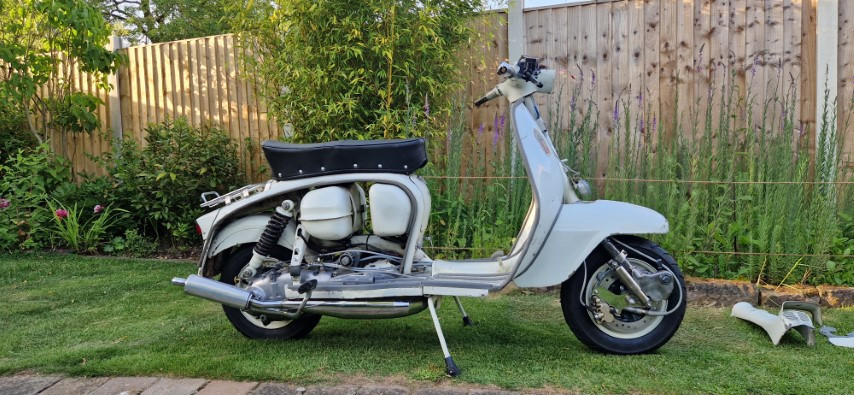


Photos below show the Lambretta in a state of completion I am happy with. As can be seen I now have the spare wheel holder fitted and the new rear shock. I’m happy with the amount of patina on the frame and bodywork, and the new parts in terms of the front disk brake, rear shock, performance exhaust and Ram Air filter on the carb give a nice balance between classic, and sporty. There is also a Cyleplus, GPS speedometer fitted to the handlebars, on an aluminium bracket. I will try and get some pictures of this soon, along with the details of where to purchase from shortly.
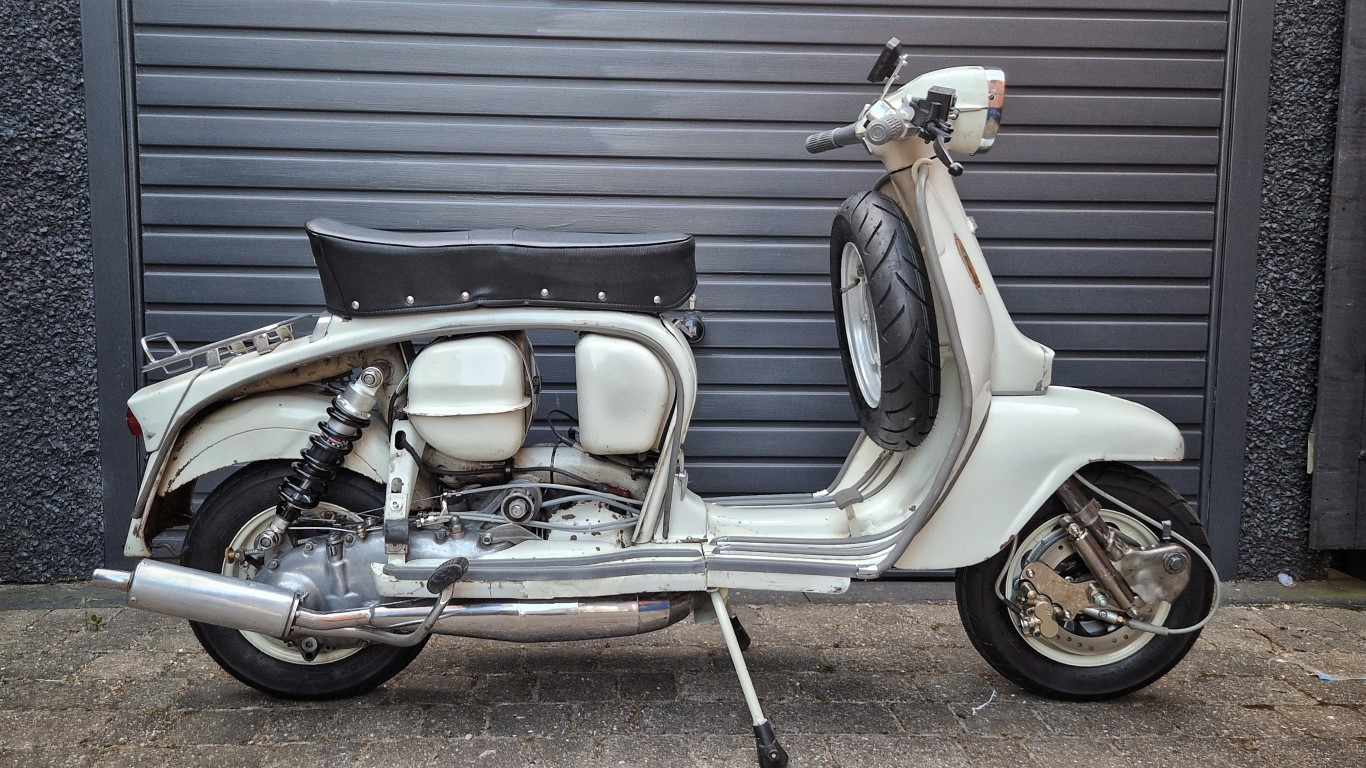
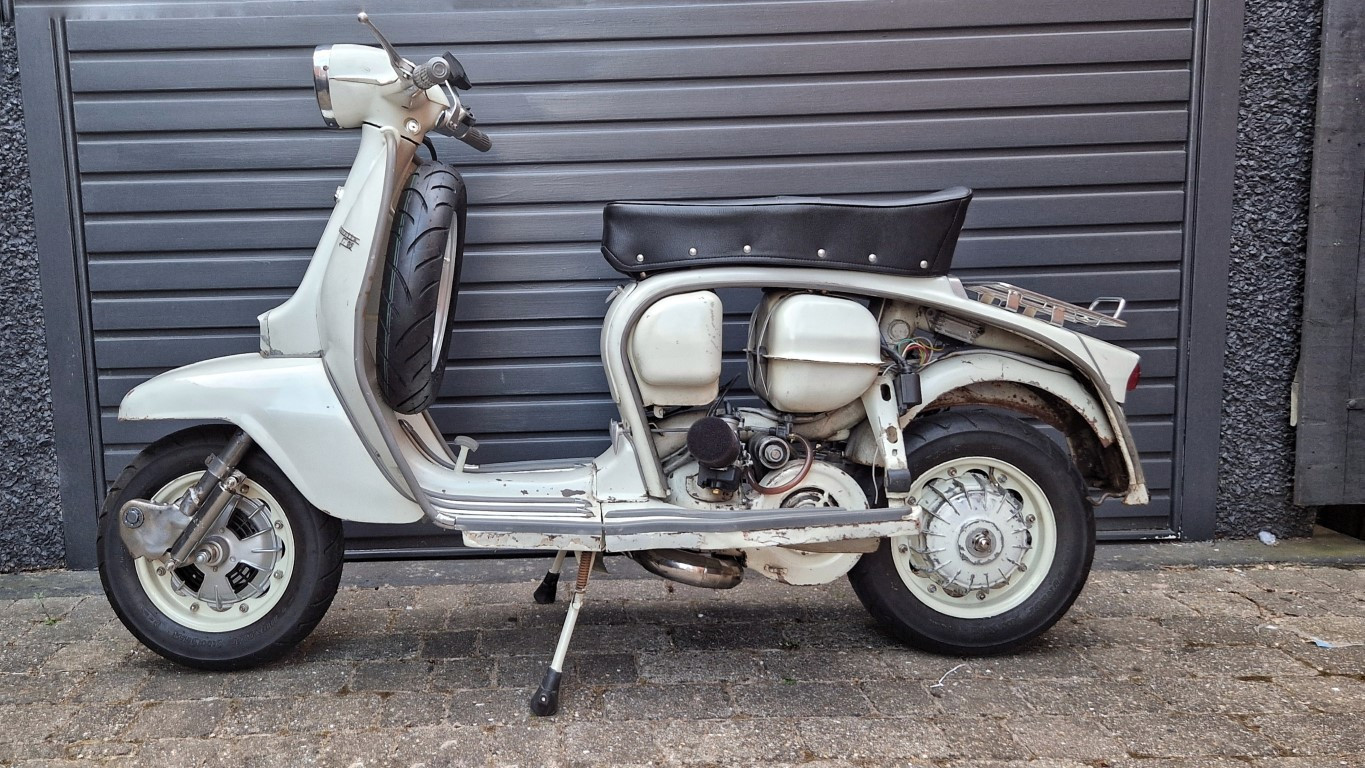
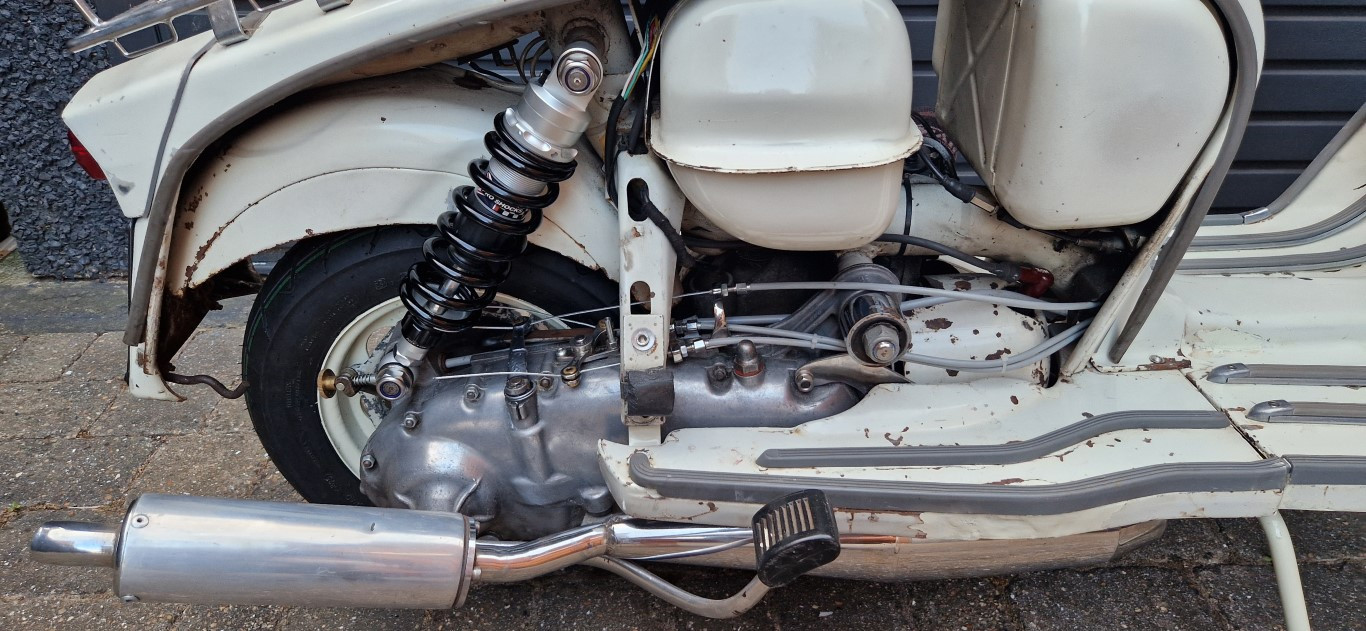

Thanks for looking. Any questions please add a comment and I’ll try and respond promptly.
Thanks
Andy
Excellent